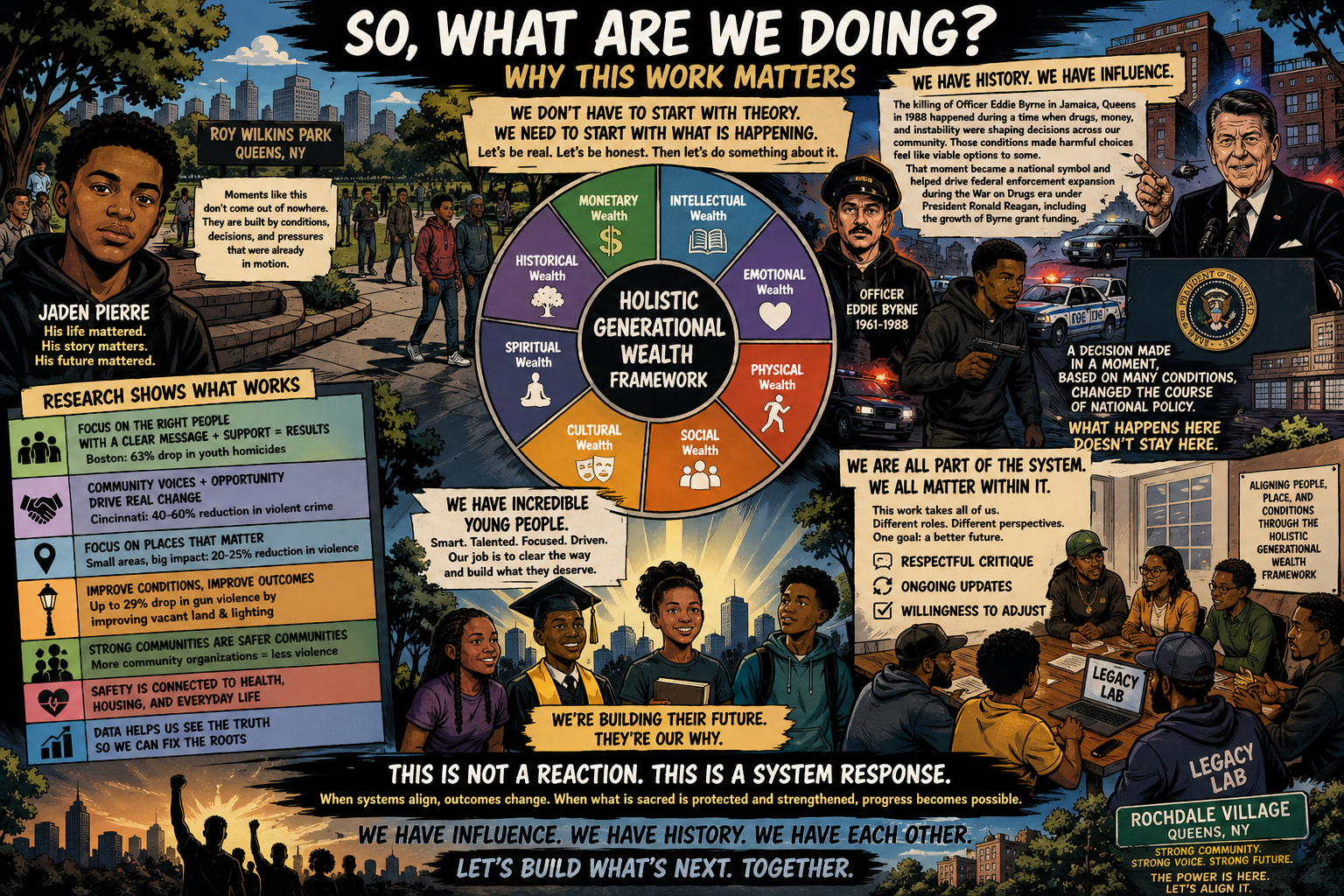
SO, WHAT ARE WE DOING?
We don’t have to start with theory. We need to start with what is happening. What we see, what we feel, the conversations that keep coming up, and the patterns that refuse to go away. Those moments force us to ask better questions. Because when something like what happened to Jaden Pierre in Roy Wilkins Park takes place, it doesn’t appear out of nowhere. It is built over time through conditions, decisions, and pressures that were already in motion.
Honesty matters here. Everyone can feel when something is off, even when it is hard to explain. This work begins by sitting in that reality long enough to understand it. From there, it becomes possible to respond with intention instead of reaction.
This is where generational wealth has to be understood in a holistic manner. What gets passed down is not limited to money. Knowledge, habits, relationships, health, identity, belief systems, and lived experience all move across generations. The Legacy Lab organizes this through the Holistic Generational Wealth framework, which considers monetary, intellectual, emotional, physical, social, cultural, spiritual, and historical wealth as connected parts of the same system. When these areas are stable, communities function. When they are strained at the same time, the outcomes begin to show.
Loss within a community affects more than the moment itself. Emotional wealth is impacted as families and peers carry that weight forward. Social wealth shifts as trust and a sense of safety begin to change. Continued strain starts to reach intellectual and monetary wealth as school engagement and access to opportunity are disrupted. Through all of this, what people hold sacred remains consistent. Life, family, safety, dignity, and the ability to move freely without fear continue to guide how people think and act. Any response that ignores those values will not last.
At the same time, it is important to recognize what is working. There are young people in this community who are focused, talented, disciplined, and moving with purpose. Their presence matters. Their success matters. Part of this work is making sure the path in front of them is clear. Removing barriers is not only about responding to harm. It is about making sure those who are already moving in the right direction have the support and space to keep going.
Research provides clarity on how to move forward. Violence is not spread evenly. It is concentrated among specific people, in specific places, and under specific conditions. In Boston, leaders studied who was involved in shootings and found that a small number of groups were responsible for most of the violence. Efforts shifted from broad enforcement to direct engagement. Clear expectations were communicated, consequences were made certain, and support was made available. Youth homicides dropped by 63% (Braga et al., 2001).
Work in Cincinnati built on that approach by bringing in credible voices from the community. Communication became more grounded, and access to real opportunities was built alongside accountability. Violent crime decreased by approximately 40 to 60 percent (Engel et al., 2014). Consistency, clarity, and opportunity working together produced results.
Place also plays a role. A small number of blocks often account for a large portion of activity. Focusing attention on those specific areas leads to measurable reductions in violence (Braga et al., 2014; Weisburd, 2015). The condition of those spaces matters as well. Improvements such as maintaining vacant lots and increasing lighting have reduced gun violence and other forms of crime (Branas et al., 2011; Welsh & Farrington, 2008). Environment influences behavior.
Community presence strengthens outcomes. Increased access to organizations, programs, and stable points of connection is linked to decreases in violent crime (Sharkey et al., 2017). Relationships create structure. Structure supports stability.
Patterns need to be understood, not ignored. Addressing root causes produces better outcomes than reacting to isolated incidents (Weisburd et al., 2010). Improving conditions, rather than relying only on enforcement, creates environments where stability can exist. Overly aggressive approaches have not shown lasting success (RAND, 2016). Real progress comes from aligning systems, not overwhelming them.
Health is part of this conversation as well. Exposure to stress, trauma, and instability increases the likelihood of harm. Reducing those exposures improves long-term outcomes (National Academies of Sciences, 2018). Safety connects directly to housing, health, and everyday life.
Technology can support these efforts when used with purpose. Targeted monitoring in high-risk areas has been shown to reduce crime and improve surrounding conditions (Piza et al., 2019). Tools work best when they support people, not replace them.
Responses must also match the situation. Access to services, education, and opportunity reduces the likelihood of repeated harm (Wilson et al., 2018). Accountability and support are most effective when they operate together.
Understanding all of this requires clear use of data. Population data shows who is affected. Location data shows where activity is concentrated. School data shows how young people are progressing. Housing data reflects stability. Health data highlights exposure to stress and access to care. Workforce data shows access to opportunity. When these are connected, patterns become visible and root issues can be addressed.
Queens has shaped national responses before. The killing of Edward Byrne took place during a period when drug economies and instability were influencing decisions across the community. Those conditions made harmful choices feel viable to some. The incident became a national symbol and contributed to expanded federal enforcement strategies during the War on Drugs era under Ronald Reagan. The response did not fully reflect the complexity of the community, yet it shows how far the influence of this place can reach.
Influence exists here. History, identity, and civic presence continue to shape that influence. Areas such as Rochdale Village are recognized for strong community engagement and a significant Black population. The ability to shape outcomes is present. Alignment determines how that influence is used.
We are all part of the system. We all matter within it. Progress requires support across roles and perspectives. Respectful critique strengthens the work. Continuous updates improve it. Real change is built through iteration, not assumption.
This work is not a reaction. It is a system response. It looks at people, place, and conditions together. It uses data to understand what is happening and aligns the full Holistic Generational Wealth framework to respond to it.
When systems align, outcomes change. When what is sacred is protected and strengthened, progress becomes possible.