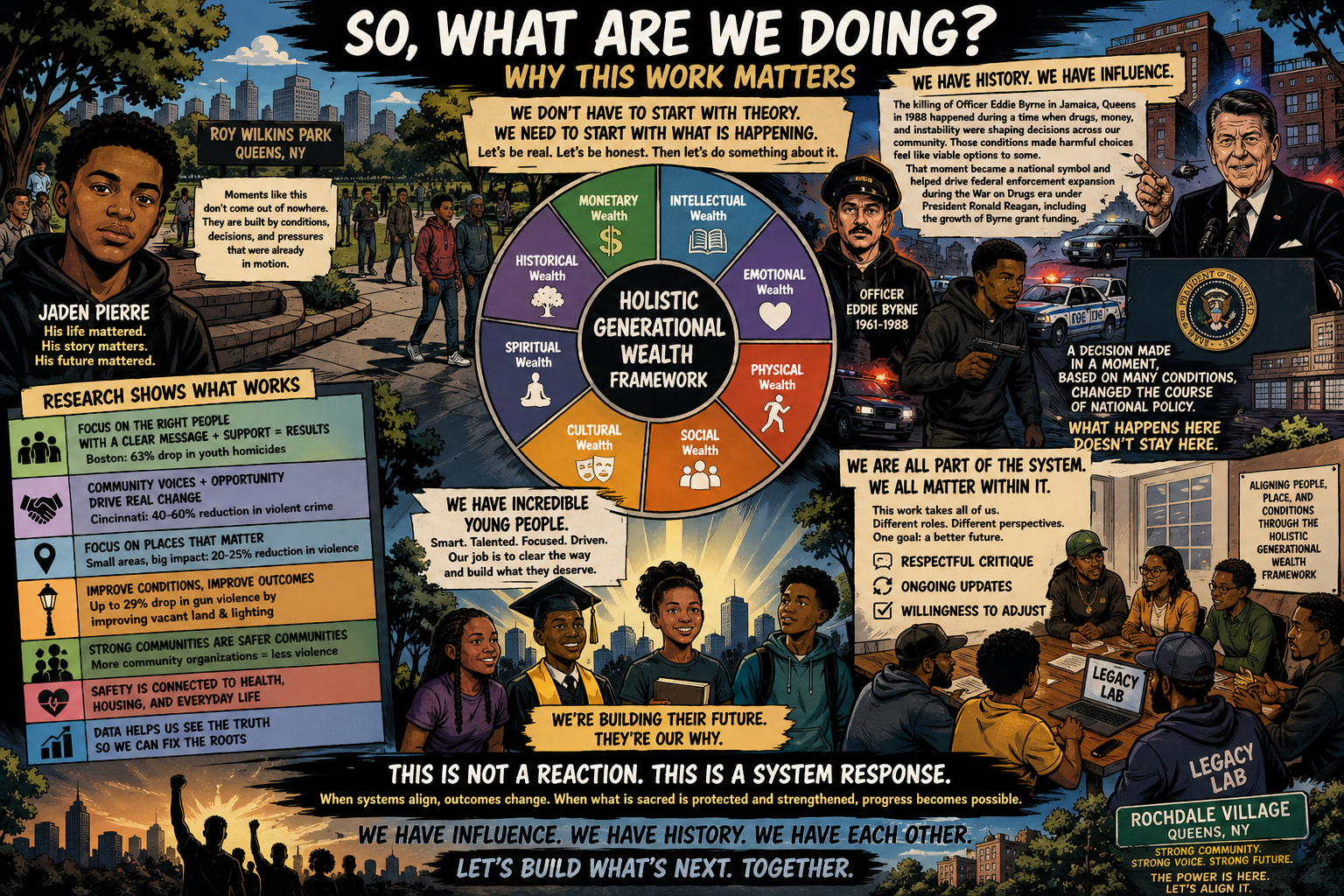
The Legacy Lab begins with a clear position. These community conditions are not random. They are produced by a bunch of systems that are either aligned or not. When something tragic happens, it is not the result of one failure. It is the result of multiple pressures building at the same time. To understand that, we approach generational wealth holistically. The way I see it, generational wealth is what everyone identifies as a goal, but most people only communicate the money. It actuality it also includes how knowledge is passed down, how families are supported, how people feel, how they stay healthy, how they connect, how they understand who they are, what they believe, and what they carry forward over time. This expanded understanding is organized through the Holistic Generational Wealth framework, which brings together monetary, intellectual, emotional, physical, social, cultural, spiritual, and historical wealth to explain how outcomes are shaped.
We don’t have to start with theories. We have to start with what’s going on. We look at what we see, what we feel, and the patterns that keep showing up. When something tragic like the Jaden Pierre murder in Roy Wilkins Park happens, it does not come out of nowhere. It is built over time through the conditions around us and the decisions people are pushed to make within those conditions.
Loss affects more than what we normally care to share. We just say families and friends carry that weight. But the overall brand of the community changes. Over time, it affects school, opportunities, and stability. Any real solution has to protect those things while strengthening the systems around them.
It is also important to recognize what is working. There are young people in this community who are focused, talented, and moving with purpose. This work is not only about reducing harm. It is about clearing the way so they can keep going and reach their full potential. And right now, the brand is to make it out. Taking away our most valuable resource, the next generation.
Research helps explain what works. Violence is not everywhere, all at once. It is usually connected to a small number of people, in specific places, under certain conditions. In Boston, community leaders focused on the small number of groups that were responsible for most of the violence and engaged them directly with clear expectations, real consequences, and access to support. Youth homicides dropped by 63% (Braga et al., 2001). In Cincinnati, they used an approach that has potential here. It included voices from the community, building real opportunities, and accountability. Violent crime decreased by about 40 to 60 percent (Engel et al., 2014). These outcomes show that people respond when the messaging is clear and real options available.
Locations matter too. A small number of blocks often carry a large portion of the activity. Focusing on those specific areas leads to reductions in violence (Braga et al., 2014; Weisburd, 2015). The condition of those spaces also matters. Cleaning, maintaining, and improving environments has been shown to reduce crime, including drops in gun violence of up to 29 percent in some cases (Branas et al., 2011; Welsh & Farrington, 2008). So, let’s report on these eyesores.
Our community presence will strengthen outcomes. Supporting all of the amazing organizations, building stronger relationships, and consistent engagement are linked to lower levels of violence (Sharkey et al., 2017). When people are connected, they are more supported and better protected. We know this, but for some reason saying “we gotta stick together” became enough activism.
Understanding these patterns is very important. Looking at why things keep happening and addressing those causes leads to better outcomes than reacting to each event (Weisburd et al., 2010). And right now, we react to each event until the next event. Improving conditions instead of relying only on punishment creates more stability, while overly harsh approaches have not shown lasting success (RAND, 2016).
Understanding all of this requires data. Looking at population, location, school performance, housing stability, health conditions, and workforce access helps reveal patterns. When those patterns are clear, real solutions can be built.
This work requires people. Some organize and bring everything together. Some use their voice to describe what the community is experiencing. Some study the data and explain what it shows. Some build programs and create spaces for growth. Some connect people and form partnerships. Some guide others and provide direction. Some support through resources. Some shape the culture. Many participate by showing up and staying engaged.
We are all part of the system. We all matter within it. Supporting each other means being honest, offering respectful critique, and continuing to improve the work over time.
Queens has influenced national responses before. The killing of Edward Byrne took place during a time when drug activity and instability shaped decisions across the community. That moment became a national symbol and contributed to expanded federal enforcement during the War on Drugs era under Ronald Reagan. It shows that what happens here can affect systems far beyond this community.
This community has influence. Places like Rochdale Village are known for strong engagement and a large Black population. The voice is here. The people are here. The influence is here. What matters is how it is aligned and used moving forward.
This is not a reaction. It is a system response. It looks at people, place, and conditions together and uses the Holistic Generational Wealth framework to guide action.
When systems align, outcomes change. When what matters most is protected and strengthened, the future improves.
25 Insights
We are inviting 25 individuals who spend real time around young people, especially in the moments when they are most themselves, to participate in one-on-one interviews about what they are seeing and experiencing. This includes people present in everyday community spaces as well as those connected to youth culture, such as DJs, artists, coaches, and others who help shape the environments young people move through. Each interview is individual, but together they will form a clear, collective understanding of youth culture in our community.
Your participation will be respected and protected. No names or identifying information will be used, and your responses will be combined with others to present shared patterns, perspectives, and insights. The findings will be organized in a way that reads as a broader conversation about youth culture, helping inform community leadership that often operates with limited real-time data. This is an opportunity to make sure what is being built reflects what is actually happening. If you are willing to speak honestly about what you see, your voice belongs in this work.